What Do You Meme? Flipped Mode: Reversed Roles Explained
Flipped reverses the roles in What Do You Meme? The Video Game. What changes, why it is not a beginner mode, and when to switch to it mid-night.
Flipped is the mode that reverses the game's roles. In Classic, the photo is fixed and players compete on captions. In Flipped, that relationship turns around: the caption side is set and the room works from the other half of the pairing. Same judge, same 1,500-point round, different creative problem.
It is the least-documented of the five modes, because the official site only says it lets you "reverse the roles". That vagueness is why groups either love it immediately or bounce off it in one round. This page covers what is actually different, why it works better as a second-session mode, and how to judge it fairly.
For the full mode list and player counts, see the game modes page→. For the base rules that still apply, the complete rule set→ is the reference.
What "reversed roles" means in practice
The constant in every mode is the pairing: one image, one line of text, one judge deciding whether the combination works. Flipped keeps the pairing and swaps which half the players control.
The consequence is that the skill changes. In Classic you are reading a photo and searching your hand for a line that fits it. In Flipped you are reading a line and working out which image would complete it. That is a different mental muscle: less "what is funny about this picture" and more "what picture would make this sentence land".
Snap Finger Click's store copy stops at "reverse the roles", so the exact interface is worth a minute of reading on the mode card before you commit a whole night to it. The strategic point stands either way: you are no longer answering a picture, you are answering a sentence.
It also changes how the judge evaluates. A Classic judge compares captions against one fixed image; a Flipped judge compares images against one fixed line. The decision is the same shape but the criteria are not. In Classic, a caption that misreads the photo fails. In Flipped, an image that misreads the caption fails, and that is a much more interesting mistake.
Why it is not a beginner mode
New players spend their first match learning the deck's sense of humour: which captions are absurd, which are observational, which are rude, which are secretly wholesome. Classic teaches that by giving them a photo and a handful of lines.
Flipped asks them to use that knowledge before they have it. A player who does not yet know what the caption cards sound like cannot predict which image will complete one. The result is a round where experienced players dominate and new players feel like they are guessing.
The fix is sequencing, not explanation. Play Classic first, let the room see a dozen winning pairings, then switch. By that point everyone has a feel for the house style, and Flipped becomes a test of imagination rather than a test of memory.
How to judge Flipped
The judge's job is the same and the trap is different.
In Classic, judges tend to reward the caption that is funniest in isolation. In Flipped, the temptation is to reward the image that is funniest in isolation — the weirdest photo, the most chaotic reaction shot — even when it has nothing to do with the line.
Judge the pairing. The question is not "is this a funny image" but "does this image make the line funnier". A boring photo that turns a flat caption into a joke beats a hilarious photo that ignores the caption entirely. Hold the line, literally.
The second trap is novelty bias. Flipped has a smaller effective space than Classic, because the caption pool is being used as prompts rather than answers, and players will start reaching for the same few images. A judge who rewards the strangest image every round will produce a very repetitive night. Reward the connection, not the shock.
When to switch to Flipped
Three moments where Flipped earns its place:
After the first session. The room knows the cards, the novelty of a new angle is welcome, and nobody is learning two things at once.
When Classic winners get predictable. If the same two players are trading rounds, Flipped resets the advantage. The skills overlap but not completely, and a strong Classic player can be mediocre at Flipped.
As a short palate cleanser. Two or three Flipped rounds in the middle of a Classic night is often better than a full Flipped session. The mode is a change of pace, not a replacement.
Do not switch to Flipped when the room is tired. It demands more invention than Classic, and a depleted table produces blank stares rather than jokes.
A large hand helps in Classic because you have more captions to match. In Flipped, a large hand gives you more prompts to choose from, which sounds good but slows the round down badly. Leave hand size where it is and let the mode be the change.
Flipped versus the other variants
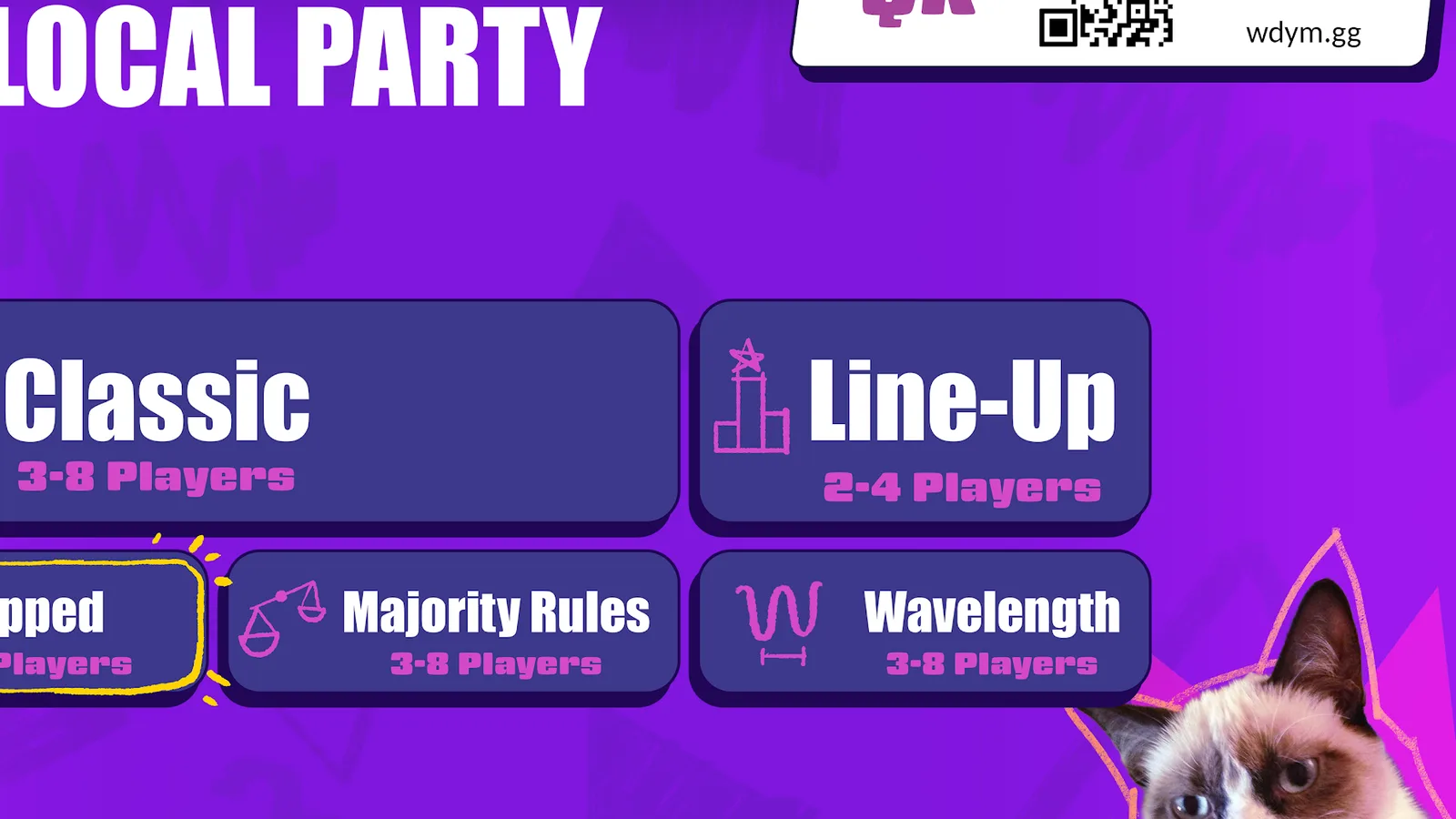
Majority Rules changes who decides, not what players make. On the Wavelength changes the goal from competition to convergence. Line-Up changes the group size. Flipped is the only mode that changes the creative direction, which is why it feels like the biggest departure despite keeping the same loop.
It also pairs well with the others. A night that runs Classic, then Flipped, then Majority Rules covers three different kinds of decision without ever feeling like a different game.
Does Flipped affect scoring?
No. A round win is still 1,500 points and the scoreboard carries across modes. The scoring page→ explains why the fixed value matters: it lets you switch modes without resetting the night or renegotiating the target.
What does change is the rate of scoring. Flipped rounds can be swingier because the judge has fewer reference points, so a player who reads the judge well can run three or four rounds in a row. If that happens, switch back to Classic rather than adjusting the points.
Where to check the details
FAQ
What is Flipped mode in What Do You Meme? It is a mode where the roles are reversed, so players work from the opposite side of the photo-caption pairing. The judge still picks the winner.
How many players does Flipped support? 3–8, the same as Classic.
Is Flipped better than Classic? It is different. Classic is the better teaching mode and the better default; Flipped is the better change of pace once the room knows the deck.
Can you switch to Flipped mid-game? Yes, between rounds. Scores carry over and the judge rotation continues.
Official rules and store pages
Official source: Snap Finger Click game page ↗ and Steam store page ↗.