
What Do You Meme? 2 Players: The Mode That Actually Works
Can you play What Do You Meme? The Video Game with two players? Yes, in Line-Up. Why Classic needs three, and how to keep a duo night from going flat.
Two-player party games are usually a compromise. The social engine is built for a room, and a duo gets a stripped version that works but never feels like the intended experience. What Do You Meme? The Video Game handles this more honestly than most: it has a dedicated small-group mode, and it tells you on the menu which modes are not for you.
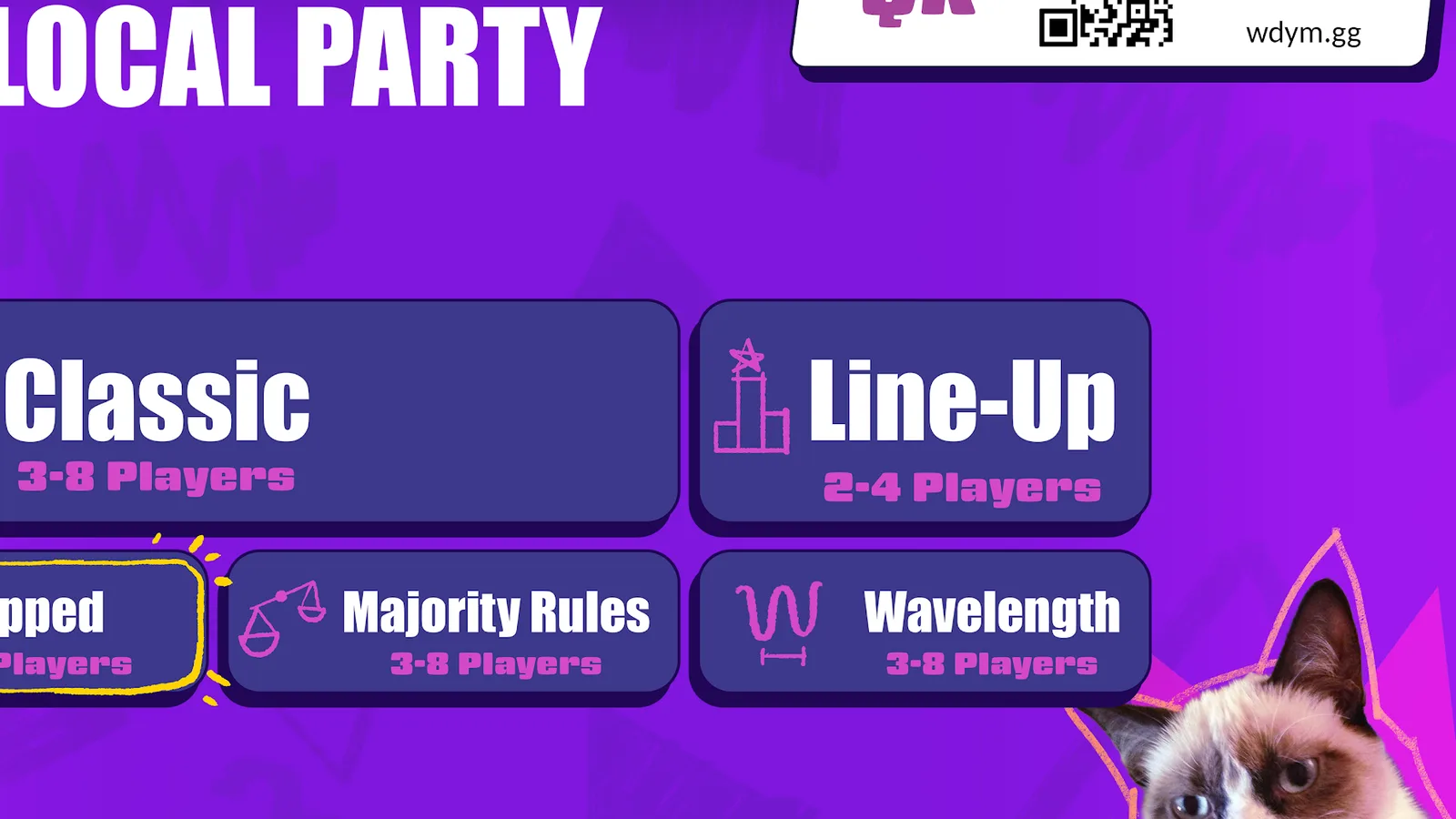
The short answer: yes, you can play with two, and the mode you want is Line-Up, listed for 2–4 players. Classic, Flipped, Majority Rules and On the Wavelength all start at three. This page covers how to make a two-player night work, what to expect from the scoring, and the alternatives if it still feels thin.
For the full mode comparison, see the game modes page→. If you are setting up the room for the first time, the setup walkthrough→ covers the join flow.
Why Classic does not work with two
In Classic, one player judges and everyone else submits. With two players, that means one judge and one submitter. The judge is not choosing between jokes; they are choosing whether to award the round. There is no competition, no comparison and no reason to play well, because the only other player is guaranteed to win if the judge is in a generous mood.
The game does not pretend otherwise. The mode cards print the player range, and Classic says 3–8. Ignoring that and forcing a two-player Classic session produces the exact experience the range is warning you about.
Line-Up is the two-player answer
Line-Up is the only mode listed for 2–4 players, which makes it the default for a couple, a two-person household or the last hour of a night when everyone else has gone home.
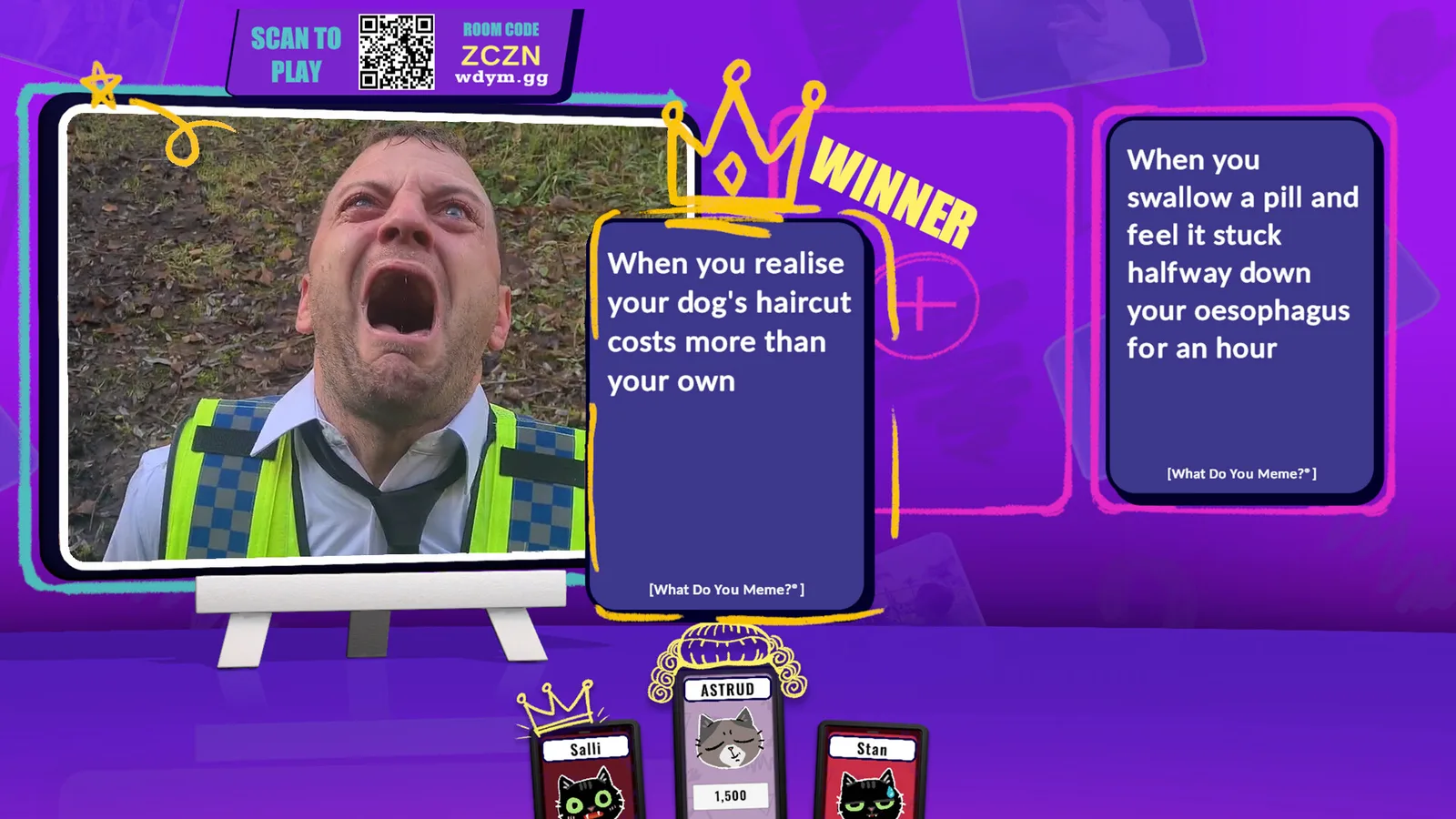
The mode keeps the core pairing — photo, caption, judge — but changes the structure enough that two players have something to compete over. The judge still rotates, so both players get turns at deciding, and the scoring still awards 1,500 points a round. The difference is that the round is designed around a small table rather than a large one.
Two practical notes:
- Expect faster rounds. With two players, there are fewer captions to read and fewer pauses. A Line-Up session moves at roughly twice the pace of a six-player Classic game.
- Expect more judge influence. With one submitter, the judge's taste is the entire game. If one player is consistently funnier to the other, the scores will reflect that quickly.
How to keep a duo night interesting
The failure mode of any two-player party game is predictability. After twenty minutes, each player knows what the other finds funny, and the rounds become a test of memory rather than a joke.
Four ways to break it:
Rotate modes. Line-Up is the only two-player mode, but you can still change the settings between matches. A shorter timer makes the game more instinctive; a larger hand makes it more considered. The settings page→ covers the options.
Change the judge cadence. Play best-of-five with the judge rotating every round, then play a stretch where the same player judges three rounds in a row and the other has to adapt. It is a different game.
Add a third player remotely. The game supports screen sharing for remote play, so a friend on Discord can watch the host screen and join the conversation even if they cannot join the room. The streaming page→ explains the setup.
Use the cards as prompts. If the competitive frame stops working, play a round where both players explain their caption out loud before the judge picks. It turns the game into a conversation, which is what a two-player night usually wants anyway.
Scoring with two players
Every round win is worth 1,500 points, the same as a full room. Because there are only two players, a single win is a large share of the total, and a lucky streak can decide the night early.
The fix is not to change the scoring; it is to shorten the session. Play to five round wins rather than to a time limit, or play first-to-three matches and reset. A two-player game that runs for two hours will always feel lopsided; a two-player game that runs for forty minutes will feel close.
Is the game worth it for a duo?
If you regularly have two players, the honest answer is that this is a party game first. The box is built for a room, and Line-Up is a good adaptation rather than a reason to buy.
If you have two players and a rotating cast of friends, it is an easy recommendation: the same copy covers a duo night and a full party, and the mode menu makes the switch trivial.
If you are buying specifically for two, look at the card packs→ before you commit. A small group sees fewer cards per session, so a pack that adds variety goes further than it would in an eight-player room.
What about three players?
Three is the minimum for Classic, and it works, but it is thin: the judge chooses between two captions, so the decision is close to a coin flip. Line-Up supports three as well, and for a group of three it is often the better choice.
The jump from three to four is the biggest improvement in the game. At four, the judge has three options and the room has enough variety for the funny caption to stand out.
Where to check the details
FAQ
Can you play What Do You Meme? The Video Game with 2 players? Yes, in Line-Up, which supports 2–4 players. Classic and the other modes require at least three.
Does two-player mode have its own rules? Line-Up is its own mode rather than a modified Classic. The judge still rotates and round wins are still worth 1,500 points.
Can two players use one phone? Each player needs their own phone to hold a hand and submit privately. Two players sharing one device would expose both hands.
Is two-player good for a couple? It works, especially for short sessions. Treat it as a small-group mode rather than the main event.
Official rules and store pages
Official source: Snap Finger Click game page ↗ and the in-game mode select screen.