
What Do You Meme? Video Game Rules: The Complete Rule Set
The full rules for What Do You Meme? The Video Game: round structure, judge rotation, scoring, hand refills, ties and the settings that change them.
The digital version keeps the card game's central bargain: one photo, many captions, one judge, one winner. What changes is the bookkeeping. The game deals the hands, hides the submissions, counts the score and rotates the judge, so the rules you need to know are the ones the software does not enforce.
This page is the full set — setup, round flow, judging, scoring, ties and the optional settings. If you just want to get a game running, the setup walkthrough→ is faster. If you are arguing about a specific call mid-match, the judge rules page→ goes deeper on the one role that decides everything.
What is in the box, digitally
The base game ships with 1,000 caption cards and 250 photo cards, which is a larger pool than most groups will see in a night. Five paid card packs and a free demo are listed on Steam; the console stores list a smaller subset of the packs. The card packs page→ tracks which pack is on which platform, because the lists genuinely differ.
There is no board, no tokens and no physical deck to shuffle. The "deck" is the pool the server draws from, and the discard pile is invisible. That matters for one practical reason: you cannot count cards, so the only strategy is reading the judge.
Setup: what the host chooses
Before the first photo appears, the host picks a mode and, optionally, adjusts three settings.
- Mode. Classic, Line-Up, Flipped, Majority Rules or Wavelength. Player counts differ; Line-Up is the 2–4 player option.
- Hand size. How many caption cards each player holds. More cards means more choice and slower rounds.
- Timer. A countdown for caption submission. The default build shows 35 seconds on the clock.
- Hall of Shame. Keeps the worst submissions visible at the end instead of discarding them.
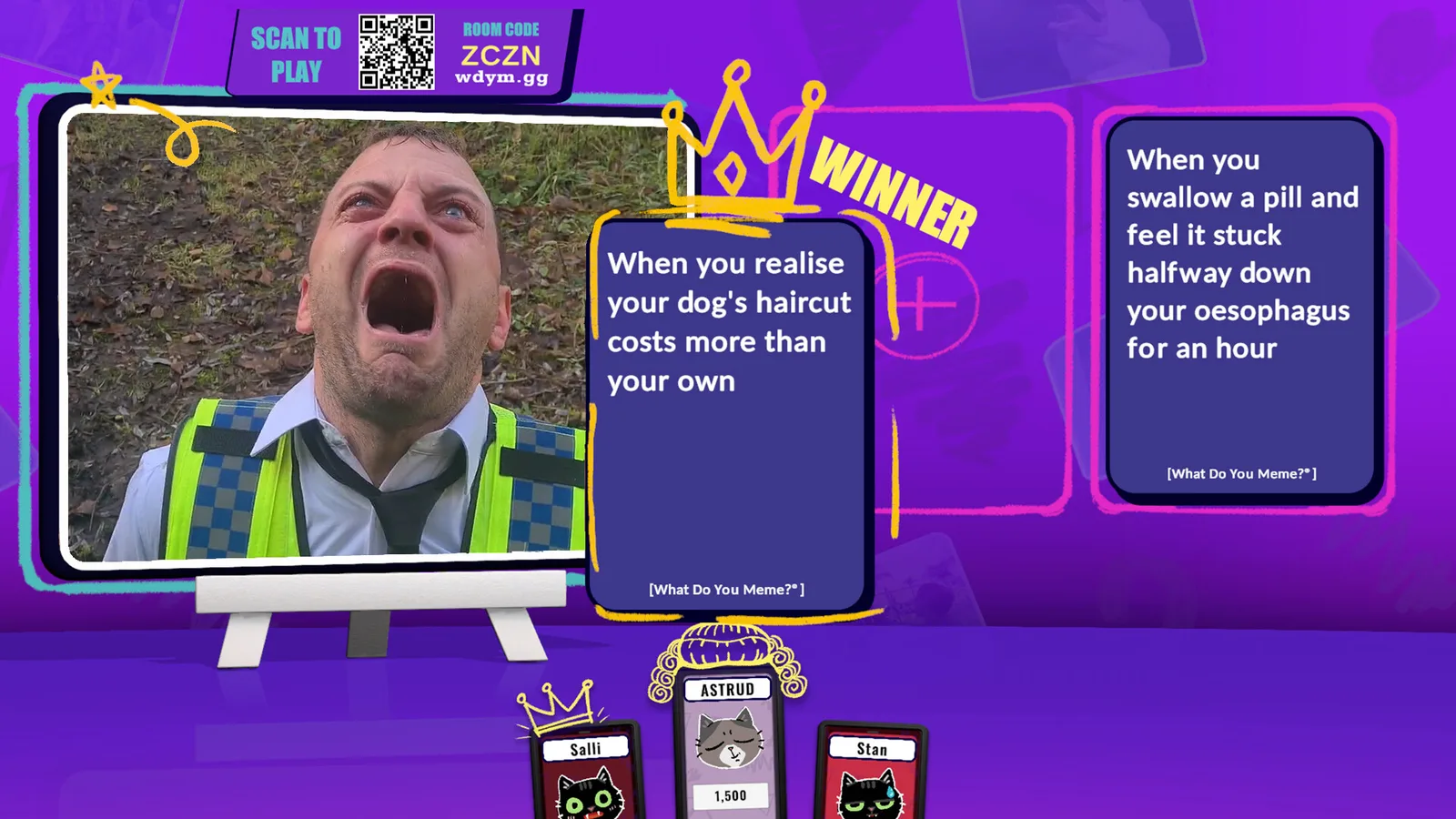
Everything else is fixed. Players join with a phone at wdym.gg using the room code, and the game assigns the first judge. No one needs to volunteer.
The round, in rules language
- The judge is designated. One player judges the round and does not submit a caption.
- A photo card is revealed on the shared screen. All players see the same image.
- Each non-judge player submits one caption from their hand. Submissions are hidden from the judge and from each other.
- The judge reviews the pairings and selects one winner. The judge may not abstain, and there is no popular vote in Classic.
- The winning player scores 1,500 points. The round ends, the pairings are revealed with names, and the next round begins.
- The judge role passes to the next player. Over a session, every player judges roughly the same number of times.
The software handles steps 1, 2, 5 and 6. Steps 3 and 4 are where human beings can still break the game.
The judge's authority, and its limits
The judge's pick is final. That is not a technicality; it is the rule that makes the game work. A room that appeals every decision spends the night in committee.
The judge has three obligations:
- Pick one winner. No ties, no "you are all winners", no refusing to choose.
- Judge the pairing, not the player. Names are hidden during the decision for exactly this reason.
- Take the joke in good faith. A caption that targets a player rather than the photo is out of bounds; a caption that is simply unfunny is a legitimate loser.
What the judge cannot do is submit a caption, vote for themselves, or skip their turn. If the judge disconnects mid-round, the sane house rule is to replay the round with the next player judging.
Scoring and winning
A round win is worth 1,500 points. Scores accumulate across rounds and the scoreboard on the TV updates after every result. There is no bonus for a close second, no penalty for a bad caption and no points for judging — the judge's reward is power, not score.
That means the session winner is the player who won the most rounds, weighted by nothing. A player who wins the first three rounds and then never wins again can still top the board. The scoring page→ explains how to read the scoreboard and how to set a session length that produces a satisfying winner.
Hand refills and running out of cards
After a submission, the game draws a replacement caption into your hand, so you always hold the hand size you started with. You cannot run out of cards in the middle of a round, and you cannot hoard a good caption across rounds — it either gets played or it sits in a hand that keeps growing in relevance as the photos change.
The practical rule for players: do not save a caption for the perfect photo. The pool is big, the perfect photo may never come, and a decent caption played now beats a great one played never.
If the judge is visibly stuck between two captions, allow a single "read it again" before they choose. It costs five seconds, it saves the judge from picking the wrong card because they misread it, and it does not change the outcome. Anything more than that turns judging into a group project.
Ties, disconnects and other edge cases
Tied session scores. The game does not appear to run a sudden-death round at launch. The clean house rule is one extra Classic round with the tied players as the only submitters and the next player judging.
A player leaves mid-session. Their hand stops submitting and their score stays on the board. If they were the judge, replay the round.
A phone dies mid-round. The player misses the submission, the round continues without them, and they rejoin with the same name if the room is still open. The controller troubleshooting page→ covers reconnecting cleanly.
Someone joins late. Late joins land in the lobby, not mid-round. Wait for the result screen; the new phone will pick up a hand on the next deal.
What the optional modes change
Flipped reverses the roles: players supply the image for a fixed caption. Majority Rules replaces the judge with a vote, so the most popular caption wins rather than the judge's favourite. Wavelength asks the table to agree on a shared answer. Line-Up is built for small groups.
Each variant keeps the same scoring currency and the same phone-controller flow, so switching modes mid-night does not reset anyone's understanding of the game. The mode pages→ cover the differences in detail.
FAQ
Does the judge play a caption in What Do You Meme? No. The judge sits out the submission step and chooses the winner. They still see the photo and every pairing.
How many points is a round worth? 1,500 points for the winning caption in the launch build. Scores carry across rounds until the host ends the session.
Can two players tie for the win? Within a round, no — the judge picks one card. Across a session, ties are possible and the game does not run an automatic tiebreak, so agree on a house rule before you start.
Are the rules the same on PS5, Xbox and PC? The round structure and scoring are the same. Card pack availability and the online features differ by platform; the platforms page→ has the current breakdown.
Official rules and store pages
Official source: Snap Finger Click game page ↗, PlayStation store listing ↗ and Steam store page ↗.