
What Do You Meme? Majority Rules Mode: When the Room Votes
Majority Rules replaces the judge with a vote in What Do You Meme? The Video Game. How it changes the round, why big groups love it, and how to handle ties.
Majority Rules is the mode where the judge disappears and the table decides. Everyone submits a caption, everyone votes, and the pairing with the most support takes the 1,500 points. It is the answer to the single most common complaint about the base game: that one person's taste is dictating the entire night.
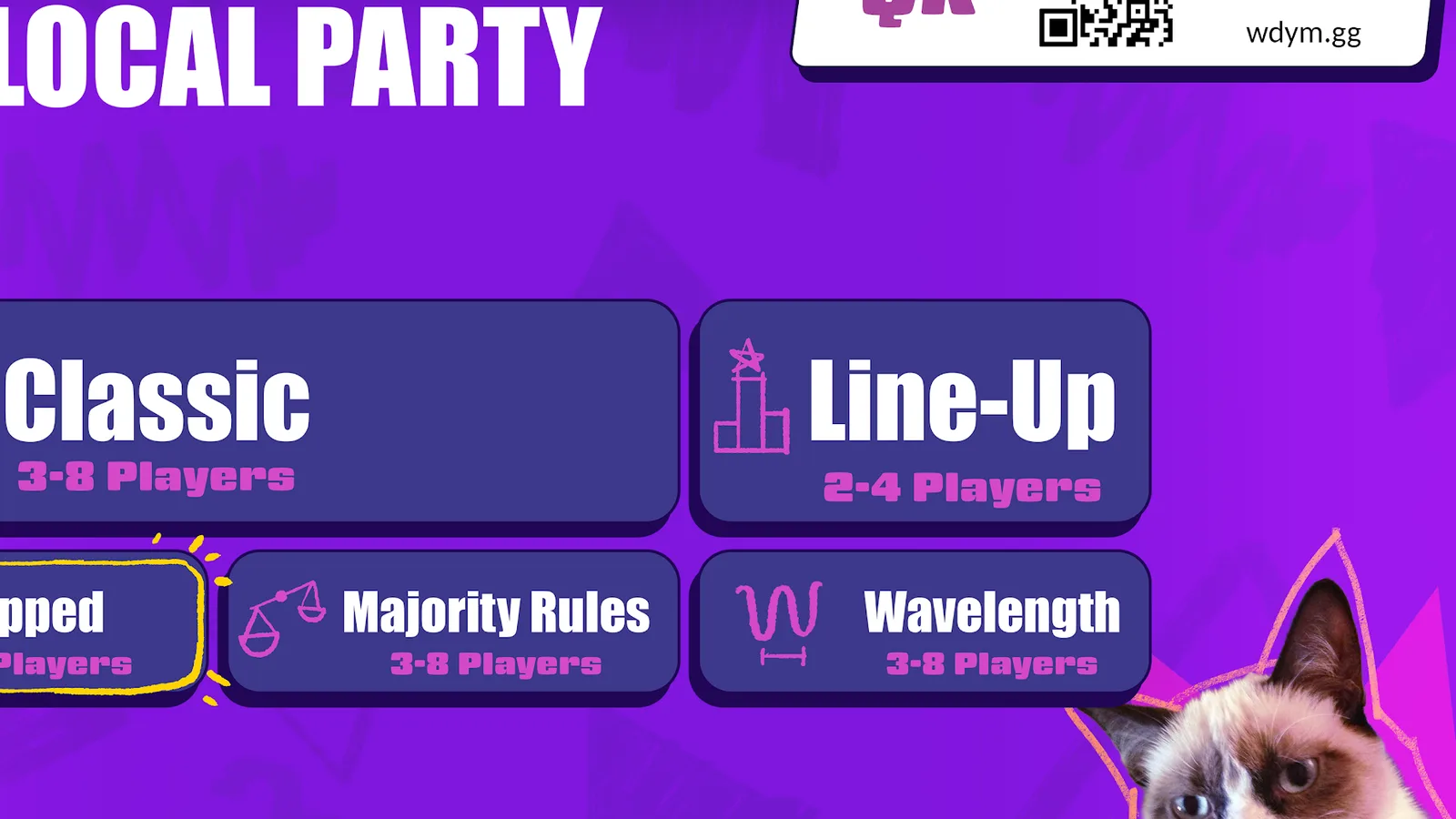
The mode is listed for 3–8 players, the same range as Classic. What changes is not the number of people but the shape of the decision. This page covers why that matters, when to switch, and the one situation where voting is worse than a judge.
For the full mode list, see the game modes page→. For the judge-based rules that still describe the rest of the game, the complete rule set→ is the reference.
How Majority Rules changes the round
The first half is identical. A photo card appears on the TV, every player picks a caption from their hand, and the submissions lock in. Nobody is sitting out.
The second half inverts. Instead of one judge choosing, the room votes on the pairings. The option with the most votes wins. The scoreboard→ still awards 1,500 points to the winner, so the value of a round does not change — only the number of people who have to agree on it.
That structural change has three consequences worth understanding before you press start.
Nobody sits out. In Classic, the judge loses a scoring opportunity every round. In Majority Rules, everyone competes every round. Over a long night this makes the scores tighter and the game feel more continuous.
The joke has to travel. A caption that only one person finds funny can still win Classic, because that one person might be the judge. In Majority Rules it needs a plurality. The humour shifts from "clever for one reader" to "legible to the room".
Coalitions form. This is the mode's real character. Players start noticing who laughs at what, and the room develops factions. That is either the best or worst thing about the mode, depending on your group.
Why big groups like it
With six to eight players, Classic puts a lot of power in one seat. A judge who does not share the room's sense of humour can flatten three rounds in a row, and the table has no recourse except to wait for the rotation.
Majority Rules distributes that power. A bad round is a round the room misjudged, not a round one person ruined. The mode also gives quiet players more influence: in Classic, the quiet player only matters when they judge; in Majority Rules, their vote counts every round.
It is also the better spectator mode. If someone is waiting for a turn, or watching a stream, the vote reveal is more legible than a single judge's decision.
Where it goes wrong
The failure mode is a room that splits into blocs. Once players realise they can coordinate, the game becomes political rather than funny, and the winning caption is the one with the most reliable allies rather than the best joke.
There is no rule against this. It is the logical outcome of a voting system, and it is why the mode is better as a change of pace than as the default for a competitive group. If you see it happening, switch back to Classic for a few rounds. The judge's authority resets the incentives.
The second failure is a low-effort room. Voting rewards captions that are broadly acceptable, and broadly acceptable captions tend to be safe. A table that votes for the safest option every round will produce a very polite, very boring night. Encourage people to vote for the joke they actually laughed at, not the one they think the group will accept.
The mode works best when everyone votes on their own screen without commentary. Once someone says "that one is obviously the winner" out loud, the vote is over. Treat the voting phase like the submission phase: quiet hands, no campaigning.
Ties, and the house rule you need
Voting systems produce ties, and the game does not always resolve them in a way the table finds satisfying. Agree a house rule before the first round:
- Re-vote between the tied options only. Fast, keeps the room involved, and usually breaks the tie.
- The photo card decides. Award the round to the pairing that used the caption closest to the photo's literal subject. Arbitrary but quick.
- No winner. Discard the round and deal a new photo. Cleanest, but it wastes a round.
Pick one and say it out loud. The worst outcome is not a tie; it is five minutes of arguing about how to resolve a tie.
Majority Rules versus Classic
Use Classic when:
- The group is new and needs to learn the deck.
- You have a strong judge who enjoys the role.
- The room is small enough that voting feels like a formality.
Use Majority Rules when:
- The group is large and the judge's taste is dominating.
- Players are getting frustrated with unfair-feeling losses.
- You want a faster, louder, more participatory round.
The two modes share the same cards, the same scoring and the same join flow, so switching between them costs nothing but a menu visit.
Does it work with two or three players?
Three players is the minimum, and it is thin: two votes decide the round, so one player's choice is often enough. Five or more is where the mode earns its name.
For two players, Majority Rules is not available. The correct mode is Line-Up, which is the only one listed for 2–4 players. The two-player page→ covers that setup in detail.
Where to check the details
FAQ
How many players does Majority Rules need? 3–8. It is listed with the same range as Classic.
Does the judge still exist in Majority Rules? No. The room votes instead of a single judge deciding.
How are ties broken? The game resolves the round, but groups should agree a house rule in advance. A re-vote between the tied pairings is the fastest option.
Is Majority Rules scored differently? No. A round win is still 1,500 points.
Official rules and store pages
Official source: Snap Finger Click game page ↗ and PlayStation store listing ↗.