
What Do You Meme? Video Game Modes: All Five Explained
Classic, Line-Up, Flipped, Majority Rules and On the Wavelength compared: player counts, how each changes the round, and which one fits your group.
The mode menu is the best thing the digital version adds to the card game, and the easiest thing to ignore. Most groups pick Classic on night one, never leave it, and then wonder why the game feels samey by round twelve. The five modes are not difficulty settings; they are different social contracts, and choosing the right one for the room is most of the hosting job.
This page compares all five: who they are for, how they change the round, and the point in a night when each one earns its place. For the underlying rules, see the complete rule set→. For the first-round mechanics, the how to play page→ is more useful than this one.
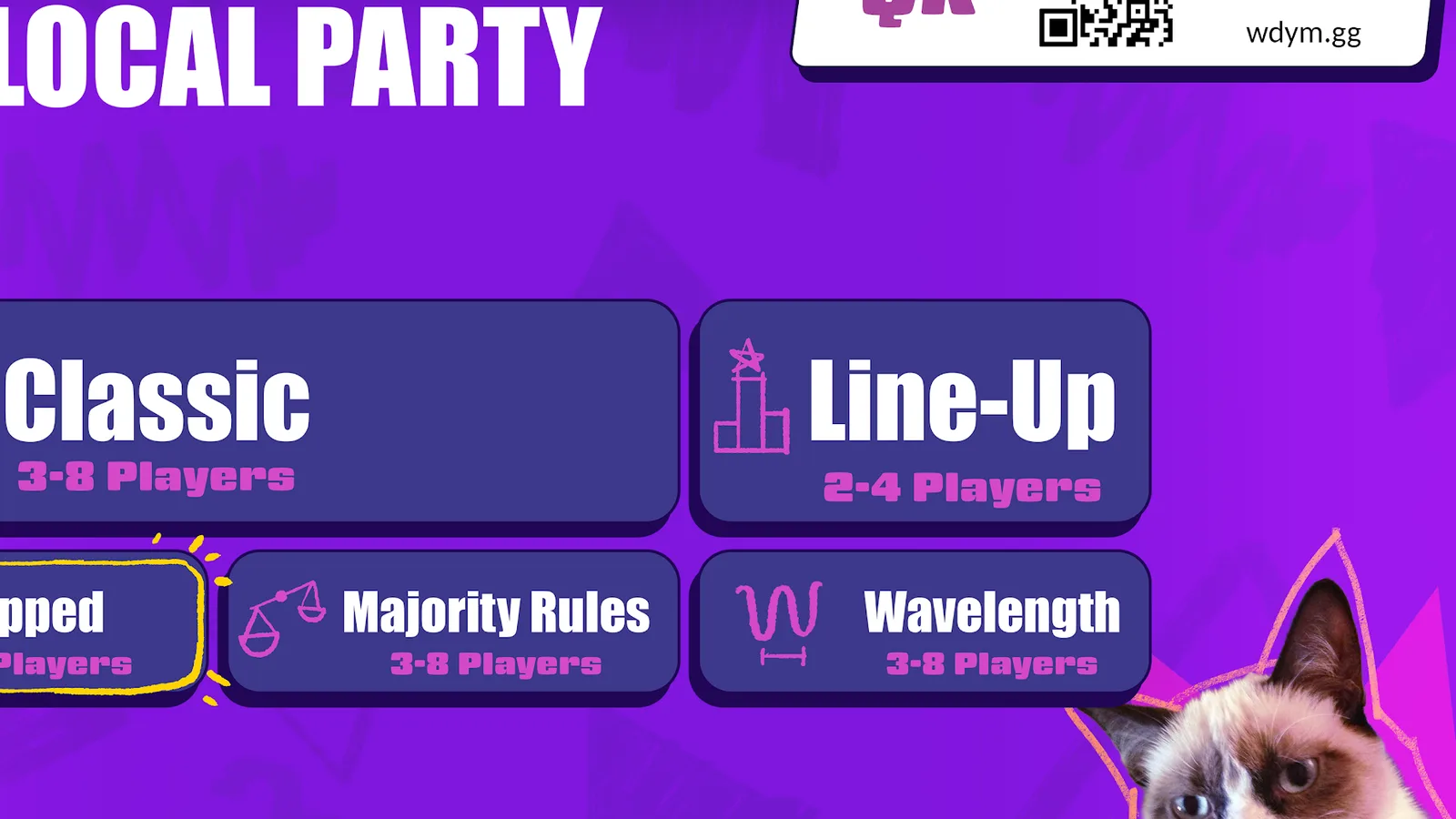
The five modes at a glance
- Classic — 3–8 players. One judge, everyone else submits a caption.
- Line-Up — 2–4 players. The small-group mode, and the only option for a duo.
- Flipped — 3–8 players. The roles are reversed.
- Majority Rules — 3–8 players. The room votes instead of a judge.
- On the Wavelength — 3–8 players. A group-psychology mode about finding the shared answer.
The player range is printed on each mode card in the menu, so you can check a group of five against the menu in five seconds. Do not assume every mode supports two players: Line-Up is the exception, and it is the reason a two-person night is possible at all.
Classic: the mode the game is built around
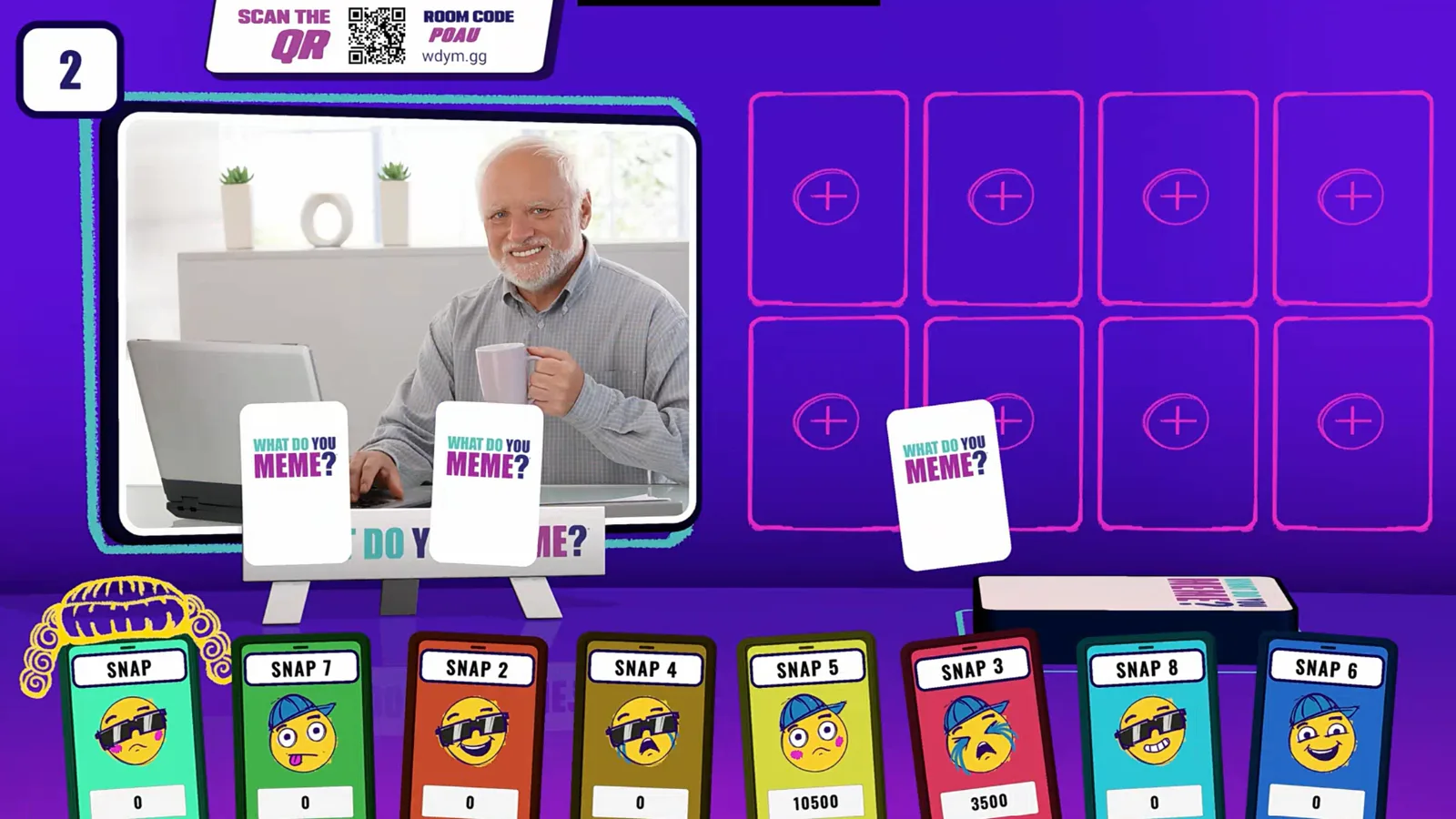
Classic is the card game: photo on the TV, caption on the phone, judge picks. It is the mode to teach first because everything else is a variation on it, and it is the mode to return to when a room gets too clever.
It scales well from three to eight. At three, the judge sees only two captions and the decision is close to a coin flip; at eight, the judge has seven options and the funny one usually announces itself. The sweet spot is five or six, where there are enough submissions for variety without the reveal taking forever.
Classic is also the most judge-dependent mode. A room with one dominant personality and a passive judge will produce predictable winners. If that starts happening, switch to Majority Rules rather than telling the judge to pick differently.
Line-Up: the two-to-four player mode
Line-Up is the mode that makes small games work. With two players, Classic has no meaningful competition — one person judges, the other submits, and the judge is essentially choosing whether to award the round. Line-Up exists to give small groups something to do that is not a formality.
It is listed for 2–4 players, which makes it the correct choice for a couple, a three-person household or the tail end of a night when half the room has gone home. The two-player page→ covers the practical side: what works, what does not, and how to keep a duo game from becoming a judge-and-audience routine.
Flipped: when the caption is the prompt
Flipped reverses the roles. The fixed half of the pairing becomes the caption and the room competes on the image side. The appeal is novelty: after a dozen Classic rounds, players have seen how the same caption archetypes win, and flipping the equation forces a different kind of reading.
It is not a beginner mode. Players need to understand what makes a pairing work before they can build one from the other direction, so save it for the second session. The Flipped mode page→ covers when to switch and how the judging changes.
Majority Rules: democracy instead of a judge
Majority Rules removes the single judge and lets the table vote. The most-voted pairing takes the round. It is the mode for rooms where the judge role creates friction — the friend who refuses to pick, the couple who always vote for each other, the parent who cannot bring themselves to reward the rude caption.
It also changes pacing. Voting is faster than judging because there is no deliberation, but the reveal is noisier and the losing side has a scapegoat. On the whole it is the best mode for a big room that has already played Classic and wants less ceremony. The Majority Rules page→ explains the voting flow.
On the Wavelength: the group-psychology mode
On the Wavelength asks the table to converge rather than compete. The fun is in discovering that four people read the same photo in four different ways, and then finding out which reading the group shares.
It is the quietest mode in the set, and the one most likely to surprise a group that thought it knew each other. It works best after the room has warmed up, not as an opener — new players are still learning the cards, and the mode asks them to predict other people's taste. The Wavelength page→ covers how to run it without turning it into a debate.
How to sequence a night
A structure that works for six players:
- Two Classic rounds to teach the loop.
- Three or four more Classic rounds while the room is loud.
- Majority Rules when the judge role starts to drag.
- Flipped when the group has seen the best Classic captions and wants a change.
- On the Wavelength as a wind-down.
Switch on the result screen between rounds, not mid-round. Scores carry across modes, so the night stays one continuous game. If the group is small, substitute Line-Up for steps three to five and keep the sessions shorter.
The right moment to switch is the round after the biggest laugh of the night. The room is still warm, the new mode gets a fair hearing, and you avoid the flat round that makes people reach for their phones.
Which mode is the fairest?
Classic is the most judge-dependent and therefore the least fair in a room with strong personalities. Majority Rules distributes the decision and feels fairer, at the cost of rewarding the safest joke. On the Wavelength is the most cooperative and the least competitive.
None of them is broken. They are measuring different things: taste, popularity, and shared context. The scoring page→ explains why the 1,500-point round value stays the same across all five.
Where to check the details
FAQ
Can you switch modes in the middle of a game? Yes. Modes are chosen between rounds or matches, and scores carry over. There is no penalty for changing.
Which mode is best for two players? Line-Up, the 2–4 player mode. Classic needs at least three to function as intended.
Which mode is best for a big group? Majority Rules at six to eight. It removes the bottleneck of one judge reading seven captions while everyone waits.
Is On the Wavelength the same as Wavelength? It is the same mode. The menu labels it Wavelength; the official site calls it On the Wavelength.
Official rules and store pages
Official source: Snap Finger Click game page ↗ and Steam store page ↗.