
What Do You Meme? Video Game Scoring: How Points Work
How scoring works in What Do You Meme? The Video Game: 1,500 points a round, how the scoreboard reads, and what actually wins a session.
Scoring in What Do You Meme? The Video Game is deliberately blunt: win the round, take the points. There are no combos, no multipliers and no bonus for a caption that makes the judge snort drink out of their nose. The game is not measuring quality; it is counting favours.
That bluntness is good news for a party. Nobody has to do arithmetic, nobody can quietly farm a corner of the rules, and the scoreboard is legible from across the room. It also means the only scoring skill that exists is the skill of guessing what one specific person will pick. The judge rules page→ covers that relationship; this page covers the numbers.
If you are still learning the round structure, start with the full rules page→, then come back here once the first 1,500 has landed on the board.
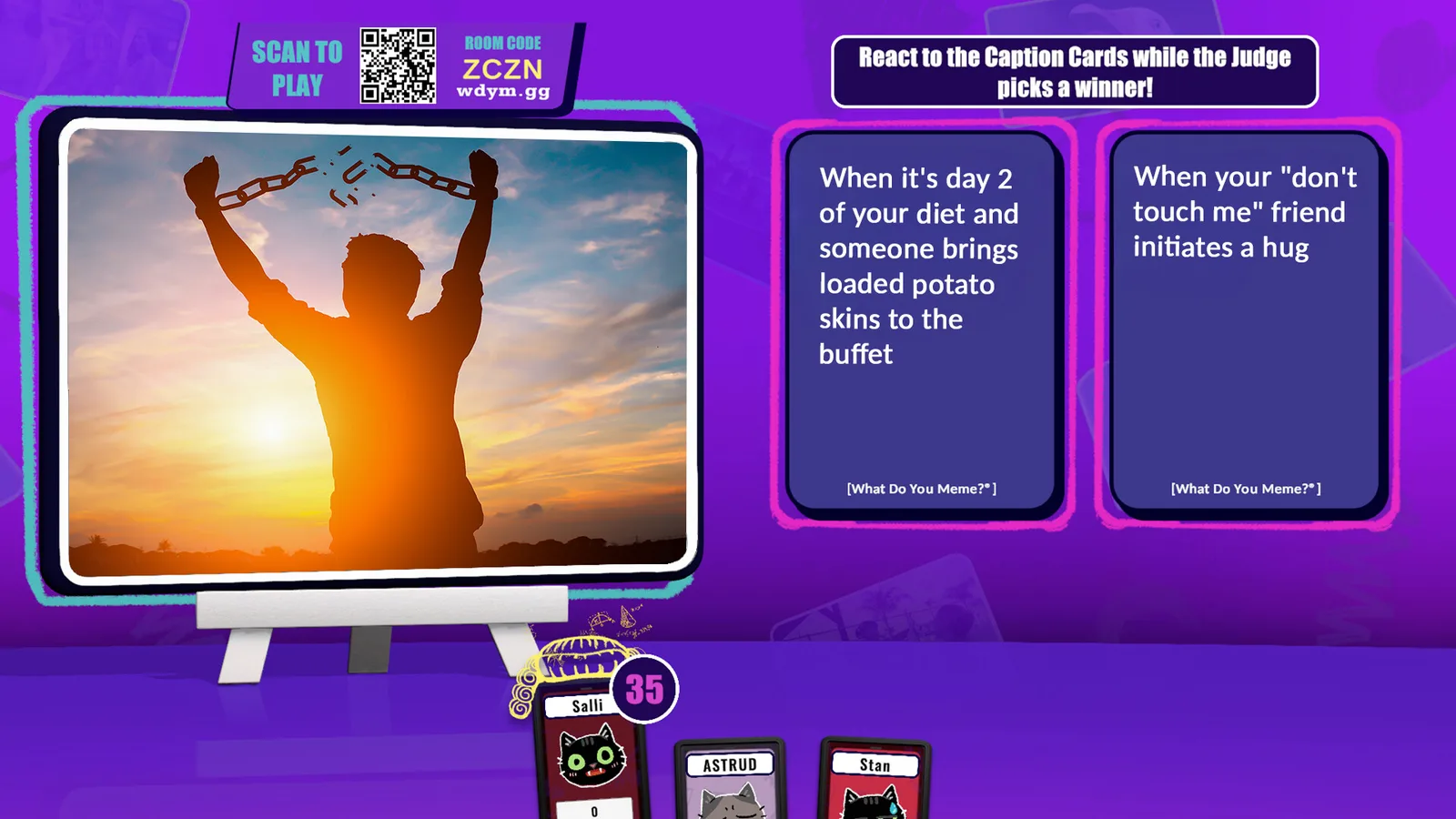
The basic unit: 1,500 points per round
A winning caption is worth 1,500 points. The number appears next to the crowned pairing on the results screen, and it is added to the winner's running total. Every round is worth the same, regardless of how many players submitted, how long the round took or how close the judge's decision was.
Because every round is equal, a session's scoreboard is really a count of round wins:
- 1 round win = 1,500
- 2 round wins = 3,000
- 4 round wins = 6,000
- 7 round wins = 10,500
That last figure is the kind of total you see on a late-night board. It does not represent a different tier of play; it represents a player who has judged a lot and won a lot of the rounds they did not judge.
What the scoreboard is telling you
The TV scoreboard shows two things that matter: the running total for each player, and the order they are sitting in. The order is not the score order — it is the join order, which is why the leader is not always at the top of the screen.
During a round, the board is mostly decoration. Between rounds it becomes the social map of the night: who is quietly winning, who has not won since the first photo, and who is about to start complaining that the judge has it in for them.
The scoreboard does not show how many rounds each player has judged. That is the missing context behind most "he is only winning because" arguments. With eight players and a rotating judge, everyone sits out roughly one round in eight, so the advantage of judging more often is small but real over a long night.
If your group plays for two hours, keep a mental tally of how many times each player has judged. The player with the fewest judged rounds has had the most chances to score. It is a better explanation for a lopsided board than any theory about taste.
Why there are no bonus points
Some party games reward speed, voting accuracy or a streak. This one does not. The design choice keeps the game accessible to the person at the table who has never played a card game and keeps the judge's decision absolute.
It also removes the main source of scoring disputes. There is no argument about whether a caption "counts", because the only thing that counts is whether the judge picked it. A caption that technically fits the photo but does not land is worth zero, and a caption that barely relates but makes the judge laugh is worth 1,500. That is the entire rubric.
The upside: a player who joins late is not mathematically out of the game. At 1,500 a round, three good rounds puts them back in contention. The downside: a player who judges badly — or whose taste does not match the room — can go a long time without scoring even while playing well.
How long a session should run
The scoreboard becomes meaningful somewhere around six to ten rounds. Fewer than that and the winner is basically whoever got lucky twice; more than that and the same two players tend to separate from the pack.
A practical structure for a four-player night:
- First to 6,000 wins (four round wins), or
- Ten rounds, highest total wins, or
- Play until the table stops laughing, which usually lands around eight rounds.
For a bigger room of six to eight, add rounds rather than points per round. The 1,500 unit is fixed and changing it would break the rhythm of the scoreboard. If you want a shorter game, lower the target; do not inflate the reward.
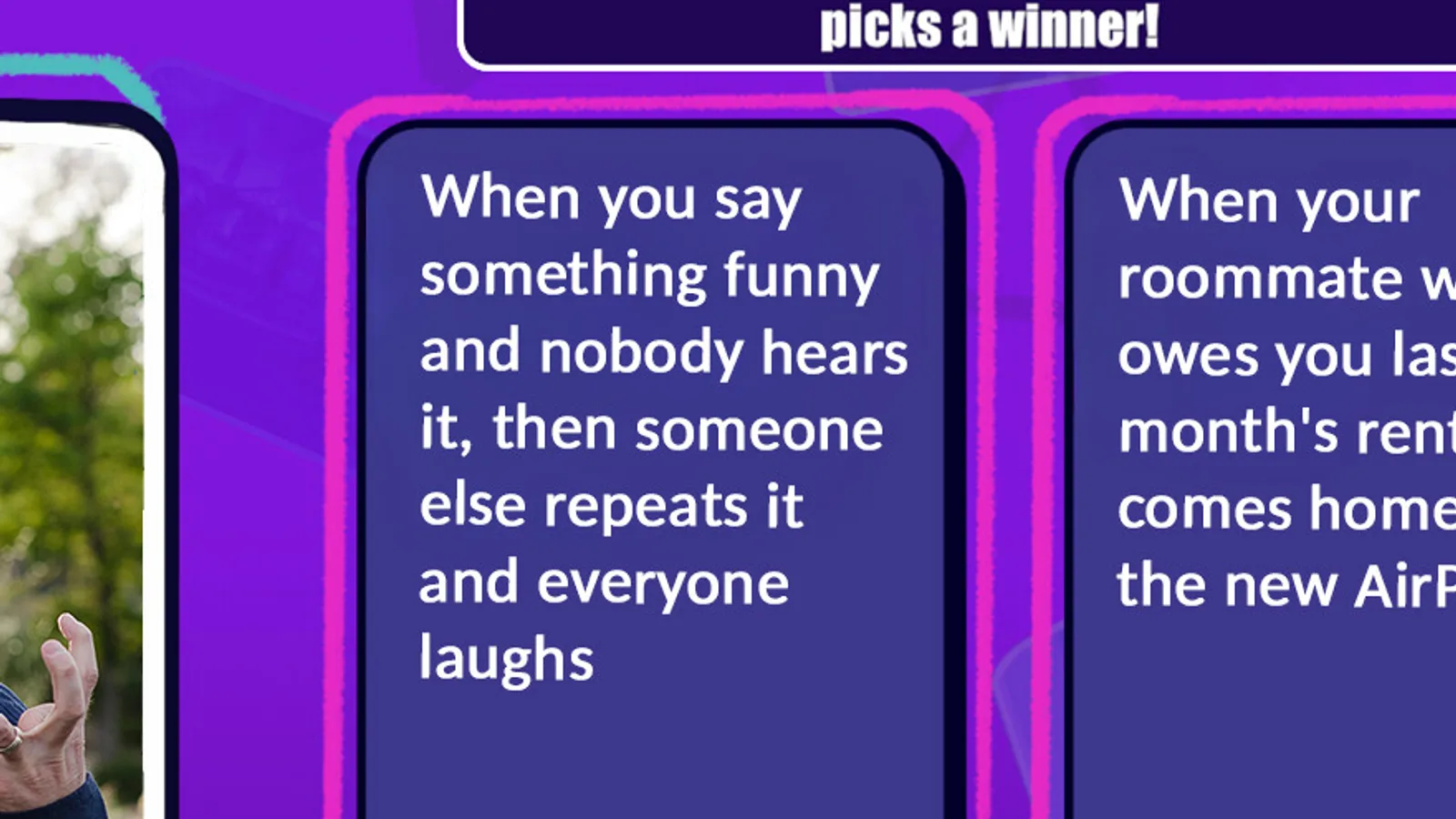
What actually produces points
Four habits separate the players who score consistently from the ones who do not.
Match the judge, not the photo. The photo suggests a topic; the judge decides the tone. A judge who likes absurd escalation will pick a ridiculous caption over a technically accurate one every time.
Read the room's energy. The first two rounds tell you what the table finds funny tonight. A group that has spent the evening on work jokes will keep rewarding work jokes; a group that has switched to family stories will not.
Avoid captions that need delivery. You are not performing the line. A caption that depends on a pause, an accent or a specific reference loses to one that lands in three words on a screen.
Do not chase the previous winner. copying the style of the last winning caption is the most common trap. The judge has already rewarded that joke once; the second version feels like a repeat, and judges punish repeats.
The caption card rankings→ break down which kinds of cards convert, and the tier list→ groups caption archetypes by how reliably they win.
Scoring in the other modes
Flipped, Majority Rules and Wavelength keep the same 1,500-point round value. What changes is who awards it:
- Flipped: the judge still picks, but players supply images instead of captions.
- Majority Rules: the room votes, and the most-voted pairing takes the round. A 1,500 award is still a single winner, not a split pot.
- Wavelength: the table converges on an answer, and the winning submission is the one closest to the group's choice.
Because the currency is unchanged, you can switch modes between rounds without resetting the scoreboard. A session that starts in Classic and moves to Majority Rules when the room gets big stays coherent.
Where to check the details
FAQ
How many points do you need to win? There is no built-in target. The host decides when the session ends; 6,000 points (four round wins) is a common house target for a four-player game.
Do second-place captions score anything? No. Only the judge's pick scores, and it scores the full 1,500.
Does the judge get points for judging? No. Judging is a round off from scoring, which is why the role rotates.
Can scores go down? No. There is no penalty mechanic in the launch build; the Hall of Shame is a display setting, not a scoring penalty.
Official rules and store pages
Official source: Snap Finger Click game page ↗ and Steam store page ↗; score values observed in official screenshots.