
What Do You Meme? Tier List: Caption Card Types Ranked
A working tier list for What Do You Meme? The Video Game captions: which card archetypes win rounds, which die, and how to pick for a judge.
A tier list for a party game is not a list of funny cards. Funny is subjective, and the judge changes every round. What can be ranked is the type of caption: how reliably it lands, how well it survives a bad photo, and how often it wins when the judge is tired, drunk or distracted.
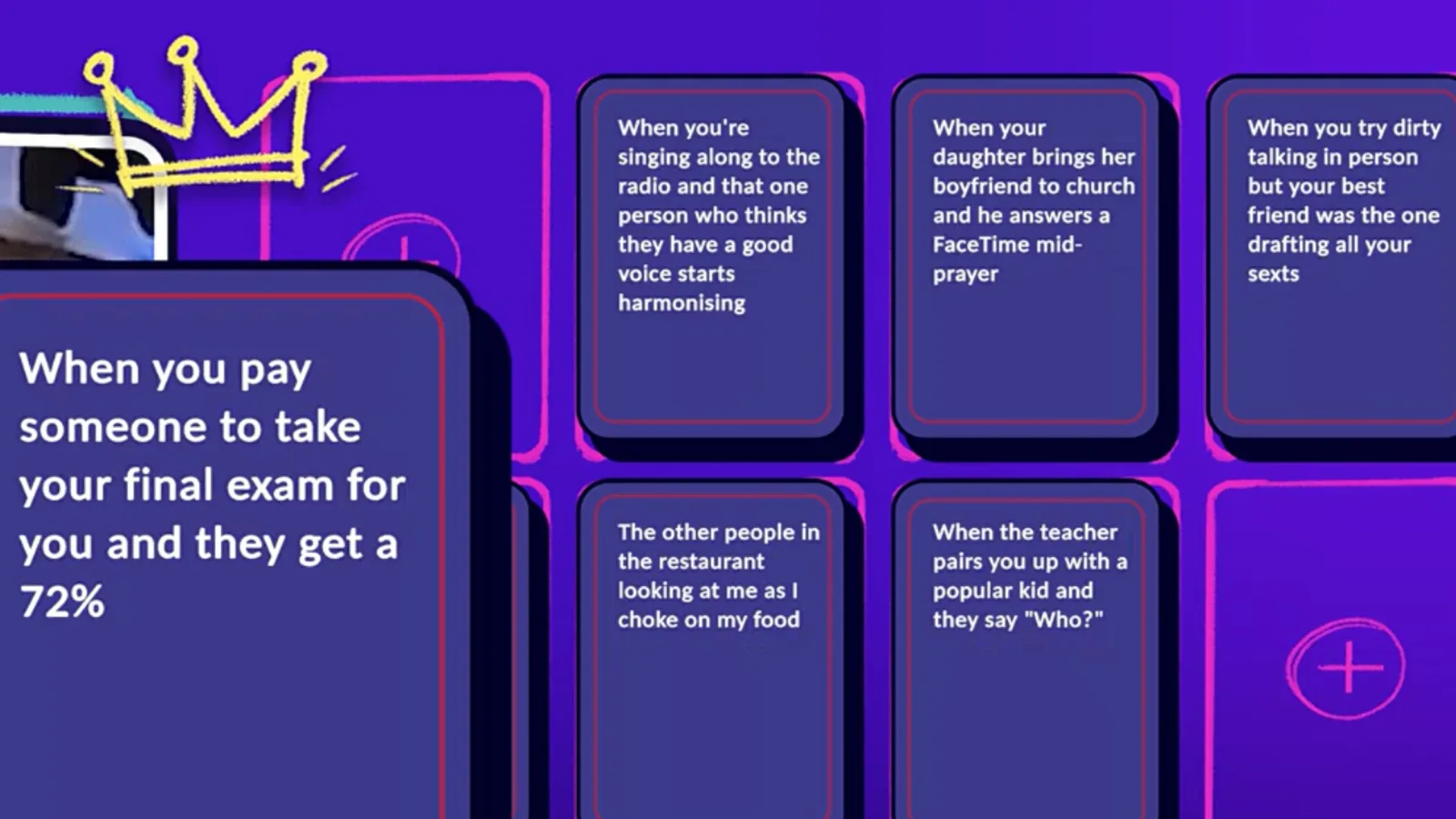
This tier list is built from the caption cards visible in the official game screenshots and from how the judge role actually works. The cards are real; the ranking is a strategy argument, not a datamined win rate.
For the individual lines worth memorising, see the best caption cards page→. For how the judge decides, the judge rules page→ goes deeper.
How the tiers are defined
- S: wins with almost any photo, and wins again when repeated.
- A: strong with the right photo, reliable in most rounds.
- B: needs a specific photo to work, but the payoff is high.
- C: funny in the abstract, hard to match to a photo.
- D: dated, niche or too literal; the card that sits in your hand all night.
The judge is the variable. A card that is S-tier with a judge who likes wordplay is C-tier with a judge who likes gross-out humour. Read the room before you read the card.
S tier: the relatable observation
The strongest captions describe a small, specific humiliation that almost everyone has lived through. They do not need the photo to explain the joke; they use the photo as a reaction face.
Real examples from the game:
- "When you realise your dog's haircut costs more than your own."
- "When you swallow a pill and feel it stuck halfway down your oesophagus for an hour."
- "When it's day 2 of your diet and someone brings loaded potato skins to the buffet."
These win because the judge does not have to work. The caption names a moment, the photo supplies the face, and the table groans in recognition. Recognition is the fastest laugh in the game.
A tier: social anxiety and small betrayals
The next tier is about other people: the friend who hugs you, the couple who fight, the colleague who extends a meeting.
- "When your 'don't touch me' friend initiates a hug."
- "When you're hanging out with a couple and they start fighting."
- "When your meeting is almost over and someone asks a question that extends it by 20 minutes."
These are nearly as reliable as S tier, but they depend more on the judge's own life. A judge who has never sat in a pointless meeting will still get it; a judge who has never been in a couple's fight will get it slightly less.
B tier: absurd specificity
Specificity is a weapon. A caption that is oddly precise can beat a generic one because the mismatch with the photo is funnier.
- "When you say you speak a little Spanish and they try having a full-blown Spanish conversation with you."
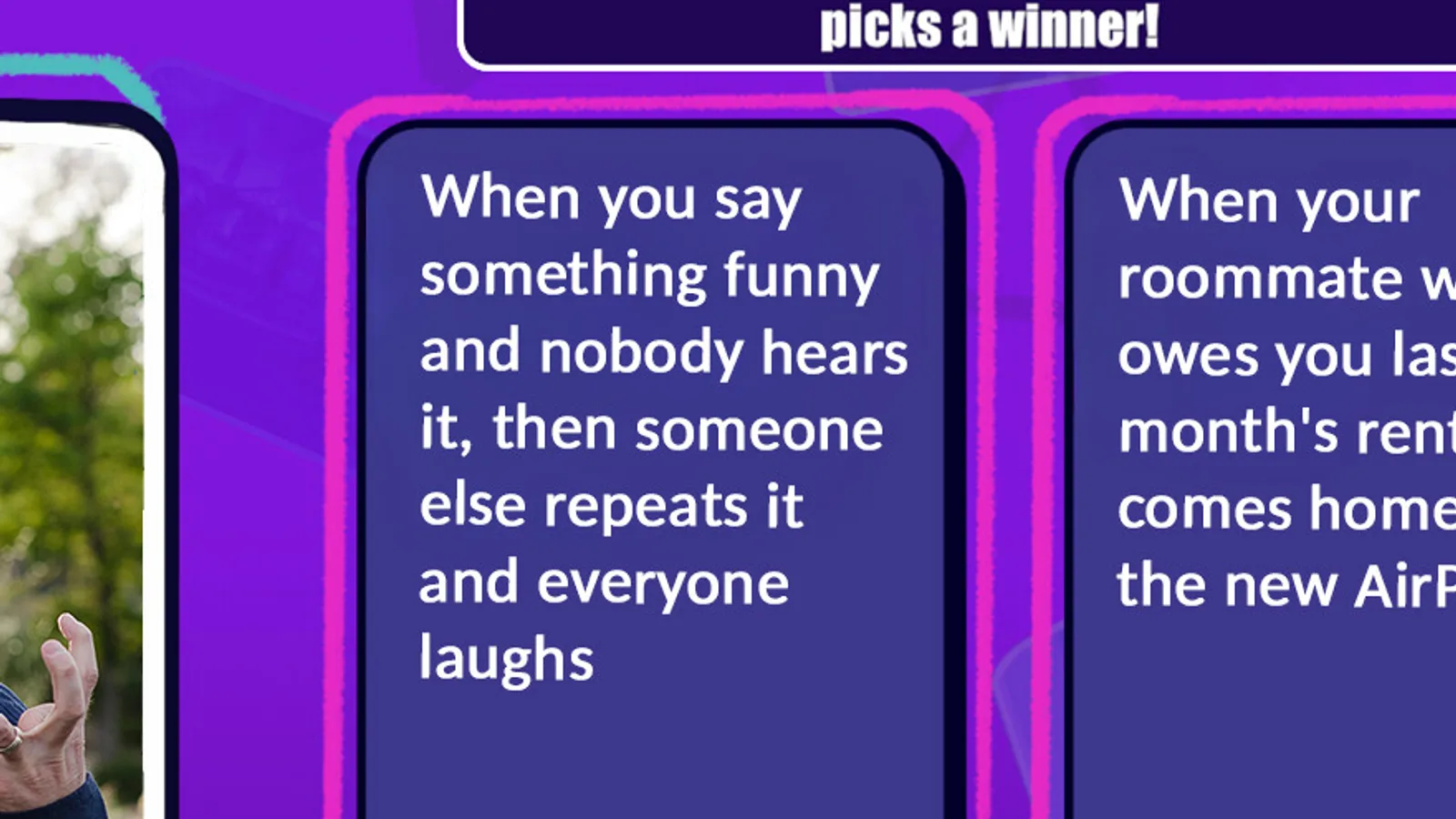
- "When your roommate who owes you last month's rent comes home with a new console."
These need the right photo. Put the Spanish line on a confident face and it wins; put it on a crying cat and it muddles. B tier is where good players separate from lucky ones.
C tier: the universal but vague
Some captions are funny ideas that are hard to attach to a picture. They describe a mood rather than a moment, so the photo has to do all the work.
- "When someone says 'There's always tomorrow' but that's the whole problem."
- "When your roommate who owes you last month's rent comes home with a new console."
Both are good lines. Both ask the judge to build the scene in their head, and that is a slower laugh than recognition. In a timed round, slow loses.
D tier: dated, niche and too literal
The bottom tier is not "bad cards". It is cards that need context the table does not have: a reference to a platform nobody uses, a pun that only works in one accent, or a literal description of the photo.
The base deck is broad enough that every group will find five or ten cards they never play. That is normal. The mistake is playing them because they are in your hand.
The judge-adjusted tier list
The same card moves up or down depending on who is judging:
| Judge type | Move up | Move down |
|---|---|---|
| Wordplay judge | Puns, misdirection | Gross-out, literal |
| Chaotic judge | Absurd specificity | Wholesome observations |
| Tired judge | Short, blunt captions | Long setups |
| Competitive judge | Anything that fits the photo exactly | Non-sequiturs |
If you know the judge, pick for the judge. If you do not, pick the most relatable card in your hand.
How to use a tier list without being annoying
Tier lists are a thinking tool, not a script. The player who announces "that's S-tier" after every play is the player nobody wants to sit next to.
Use the tiers to decide between two cards in the last five seconds of a round. Do not use them to argue with the judge. The judge's decision is final, and the scoring page→ explains why arguing costs you more than it wins.
Does the tier list change with card packs?
Yes, in one direction: the packs add more captions in the same archetypes, so the relative order holds. Fresh Memes 1 and 2 mostly add S and A tier material; Family Edition adds clean versions of the same instincts; After Hours adds a harder R-rated register that either wins the room or empties it.
If you own the packs, the tier list gets deeper rather than different. The card packs page→ covers what each one adds.
Where to check the details
FAQ
What is the best caption card in What Do You Meme? The Video Game? There is no single best card. Relatable observations such as the dog haircut and the stuck pill win most often because they need the least explanation.
Is this tier list official? No. It is a strategy ranking based on the judge role and real cards shown in the game's screenshots.
Do card packs change the tier list? They add more cards in the same categories, so the order stays roughly the same.
Should I always play the highest-tier card? No. Match the card to the photo and to the judge. A B-tier card that fits the photo beats an S-tier card that does not.
Official rules and store pages
Official source: Snap Finger Click game page ↗ and Steam store screenshots ↗.