
What Do You Meme? On the Wavelength Mode Explained
On the Wavelength is the group-psychology mode in What Do You Meme? The Video Game. How it differs from Classic, and why it rewards reading the room.
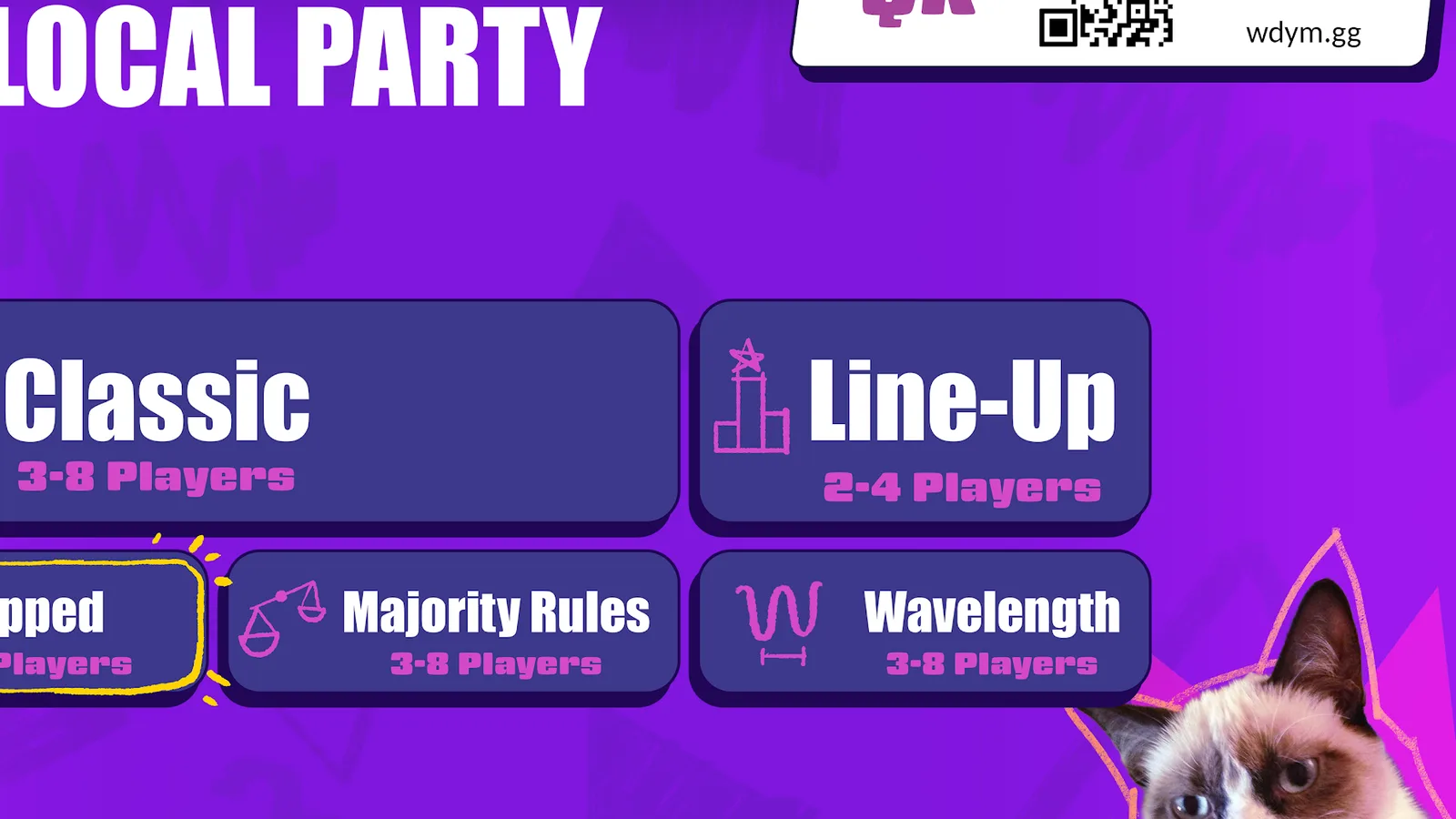
On the Wavelength is the mode the official description sells as a test of "group psychology". That phrase is doing a lot of work. Where Classic asks whether one judge finds a pairing funny, On the Wavelength asks whether the room is thinking the same thing — and those are different skills, different failure modes and a different kind of evening.
It is listed for 3–8 players, like most of the menu. This page explains what the mode is for, how it changes the way you pick a caption, and why it is the best mode for a group that has stopped laughing at each other's jokes.
The game modes page→ has the full menu comparison; the complete rules→ cover the parts that never change.
What "group psychology" means at the table
Every mode in the game is a guessing game about people. Classic asks: what does the judge find funny? Majority Rules asks: what will the room vote for? On the Wavelength asks: what is the room most likely to think of at the same time?
That last question changes your caption choice more than it looks. In Classic, the winning play is often the strangest caption in your hand, because a surprising joke stands out against six other submissions. In a convergence mode, surprise is a liability. You are not trying to be the funniest person at the table; you are trying to be the most representative one.
The practical shift: pick the caption the group would pick, not the caption you would pick. If the photo is a dog in a cone, the room's first thought is probably the vet, the shame, or the costs. Being the player who goes there first is the skill.
Why it suits certain rooms
On the Wavelength works best with people who have played together before. A group of strangers has no shared references, so "what would the room think" has no answer. A group of friends who have known each other for years has an enormous amount of shared context, and the mode turns that into a game.
It is also the best mode for a room that has become too competitive. Classic and Majority Rules both reward winning; On the Wavelength rewards being in sync. A player who keeps losing at Classic can be excellent at this, because the skill is empathy rather than joke-writing.
And it is the mode most likely to produce the night's best moment: the reveal where four people submitted the same idea. That is not a bug. That is the point.
How to play it well
Three habits separate good Wavelength players from passengers.
Read the photo literally first. The obvious subject is the group's shared starting point. Before you reach for the ironic caption, check what the plain reading is. If the plain reading is strong, half the room is already there.
Watch the room's taste, not your own. The group has a style: dry, chaotic, wholesome, rude. Pick the caption that matches the style, not the one that matches your personal sense of humour.
Do not overthink the hand. The longer you stare at five captions, the more likely you are to pick the clever one instead of the representative one. First instinct is usually the group instinct.
If the photo and caption were a message in your group chat, would someone reply instantly? That is the Wavelength target. A caption that needs a beat to land is a Classic caption, not a Wavelength one.
What the mode is not
It is not cooperative in the sense of a team game. Players still compete, scores still accumulate, and someone still wins the night. The cooperation is in the guessing, not in the outcome.
It is also not a personality test. A quiet player can be excellent at reading the room, and the loudest player can be consistently wrong about what everyone else is thinking. That is part of the appeal.
And it is not a replacement for Classic. The modes solve different problems: Classic is the default social loop, Wavelength is the corrective for a group that has become too predictable or too adversarial.
Wavelength versus Majority Rules
Both modes ask you to think about the group, but they ask at different moments.
Majority Rules lets you see the submissions and then vote. You are reacting to actual options. On the Wavelength asks you to predict before you see anything. That makes Wavelength harder and, for the right group, funnier — you are committing to a read of the room with no information beyond the photo.
If your group likes the idea of Wavelength but wants more control, Majority Rules is the easier version of the same instinct. If your group finds Majority Rules too political, Wavelength removes the campaigning entirely.
When to switch to it
Put On the Wavelength in the middle of a night, not at the start. New players need Classic to learn the deck, and they need a few rounds before they can read the room's taste. Once the table has settled, the mode gives the evening a second act.
It is also a good final mode. The last thirty minutes of a game night are usually low-energy, and Wavelength's "we all thought the same thing" moments are gentler than a competitive finish.
Where to check the details
FAQ
How many players does On the Wavelength support? 3–8, according to the mode select screen.
Is On the Wavelength cooperative? No. Players still compete and the scoreboard still decides the night. The cooperation is in predicting the group, not in sharing a win.
Does it use the same cards? Yes. It draws from the same caption and photo pools, so card packs apply.
Is it good for new players? It is better as a second mode. Play Classic first so the group has a shared sense of the deck.
Official rules and store pages
Official source: Snap Finger Click game page ↗ and Steam store page ↗.