
Does the Judge Play in What Do You Meme? Rules Explained
No, the judge does not submit a caption. How judge rotation works in the video game, what the judge controls, and how to judge without starting a riot.
No. The judge does not play a caption in the round they judge. They see the photo, they see every submitted caption once the hands are locked, and they pick the winner. Their phone stays out of the submission phase entirely.
That single rule causes more confusion than anything else in the game. New players wait for a hand that never arrives, hosts explain it badly, and someone always asks whether the judge is allowed to vote for their own card. This page answers those questions and explains how to judge in a way that keeps the table on your side.
For the wider rule set, see the complete rules page→. For how the judge's pick turns into points, the scoring page→ has the numbers.
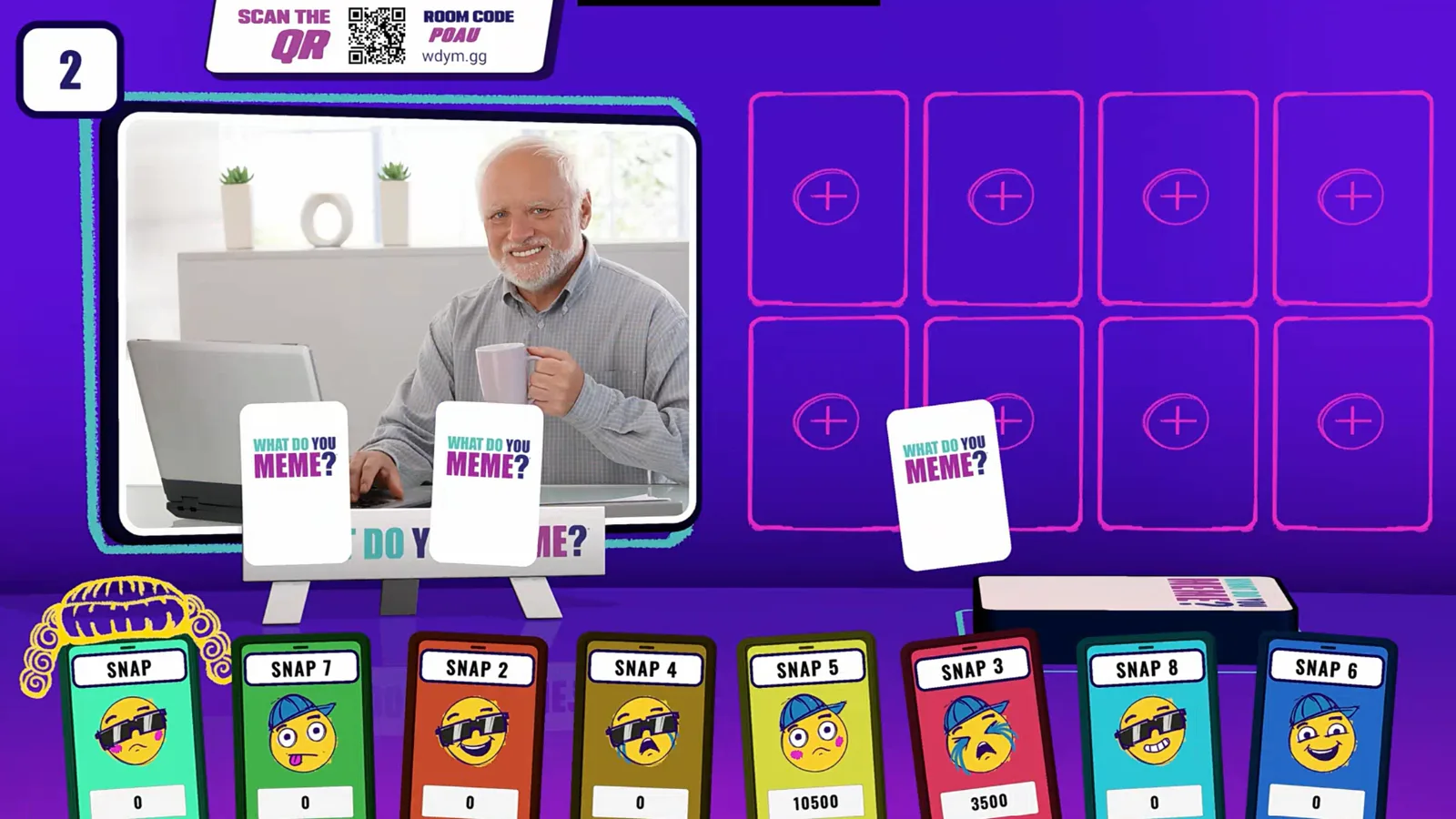
What the judge actually does
The judge's job has three parts, and only one of them is visible on screen.
Before submissions: the judge looks at the photo card and thinks about what would be funny. They are not choosing a caption, but they are setting the target the rest of the room is aiming at.
During submissions: the judge waits. The TV may show how many players have locked in, but not what they picked. This is the only downtime in the game, and it is why a judge who fills the silence with commentary makes the round feel longer.
After submissions: the judge reads each pairing and picks one. The pick is final. The winning player gets 1,500 points and the judge hands the role to the next person.
The judge never sees player names attached to captions during the decision. That is intentional: it prevents the "I'm voting for my friend" problem and forces the judge to reward the joke rather than the person.
Why the judge sits out
The judge is the game's randomiser. If the judge also submitted a caption, they would be choosing between their own joke and everyone else's, and the role would collapse into either self-voting or performative humility. Sitting out keeps the decision clean.
It also solves a fairness problem in a rotating role. Over a session, every player judges roughly the same number of rounds, so everyone loses the same number of scoring opportunities. In an eight-player room, that is one round in eight; in a three-player room, it is one in three, which is why small games feel much more swingy.
Judge rotation, and what happens when it breaks
The game rotates the judge automatically. You do not need to track whose turn it is, and you cannot volunteer to judge twice in a row.
Rotation breaks in three predictable ways:
The judge leaves. If the judge disconnects or walks away mid-round, the round cannot finish. The clean house rule is to discard the round, pass the judge role to the next player and replay with a fresh photo. Do not try to promote a player who already submitted.
The judge does not understand the role. They sit staring at a phone with no cards. The fix is to say the sentence out loud before the first round: "You are choosing this round, not playing." It saves a minute every night.
The judge refuses to pick. Some players genuinely freeze between two good captions. Allow one reread, then ask them to pick. A judge who is allowed to abstain turns a 40-second round into a committee meeting.
A judge who explains why they picked a caption is entertaining for one round and exhausting by the fourth. Pick, let the reveal do the work, and move on. Save the commentary for the Hall of Shame at the end of the night.
How to judge well
Good judging is mostly good reading. Four habits make the difference.
Reward the pairing, not the caption. A caption that is funny on its own but does not connect to the photo is a worse submission than a simpler caption that clicks with the image. Look at the combination.
Judge the room's taste, not yours. You are not choosing the objectively funniest card; you are choosing the card that this table, tonight, will enjoy seeing win. If the room is in a silly mood, the stupid caption is the correct pick.
Do not reward the explainer. If a caption only works after the player explains it out loud, it did not work. Reward the card that landed without help.
Spread the wins, but not artificially. Over a night, judges who always pick the same player create a boring scoreboard. That is not a reason to pick a worse caption, but it is a reason to genuinely reconsider when two captions are close.
Judge rules in the other modes
Majority Rules removes the judge entirely. Every player votes, the most-voted pairing wins, and ties are resolved by the game or by a house rule. It is the right mode for a room that cannot agree on who should judge.
Flipped keeps a judge but reverses the material: the caption is fixed and players submit images. The judge's role is identical — pick the pairing that works.
Wavelength turns judging into a group exercise. The table converges on an answer rather than one person deciding, which makes it the least confrontational mode in the set.
The modes page→ covers player counts and pacing for all five variants.
Judge etiquette that prevents arguments
Three social rules do more than any mechanical fix.
- No campaigning. Players should not explain their caption while the judge is deciding. The card has to stand alone.
- No post-decision appeals. Once the winner is revealed, the round is over. Losing players can complain in the next round, when they are writing a better caption.
- No targeting players. A caption that insults a specific person at the table is not a joke about the photo. Judges should not reward it, and hosts should say so before the first round when the group is new.
Where to check the details
FAQ
Can the judge vote for their own caption? No, because the judge does not submit one. If a judge is also a player in a variant that allows it, the game handles the separation; in Classic the role is exclusive.
Does the judge see who submitted which caption? Not during the decision. Names are revealed after the winner is picked.
Does the judge earn points? No. Judging is a round without scoring, which is why the role rotates evenly.
What if the judge is the last player left in the room? The round cannot continue. End the session, or restart the lobby so the judge role can be reassigned cleanly.
Official rules and store pages
Official source: Snap Finger Click game page ↗ and PlayStation store listing ↗.